Simple Sequence Repeats Drive Evolvability and Adaptive Tracking in Staphylococcus aureus
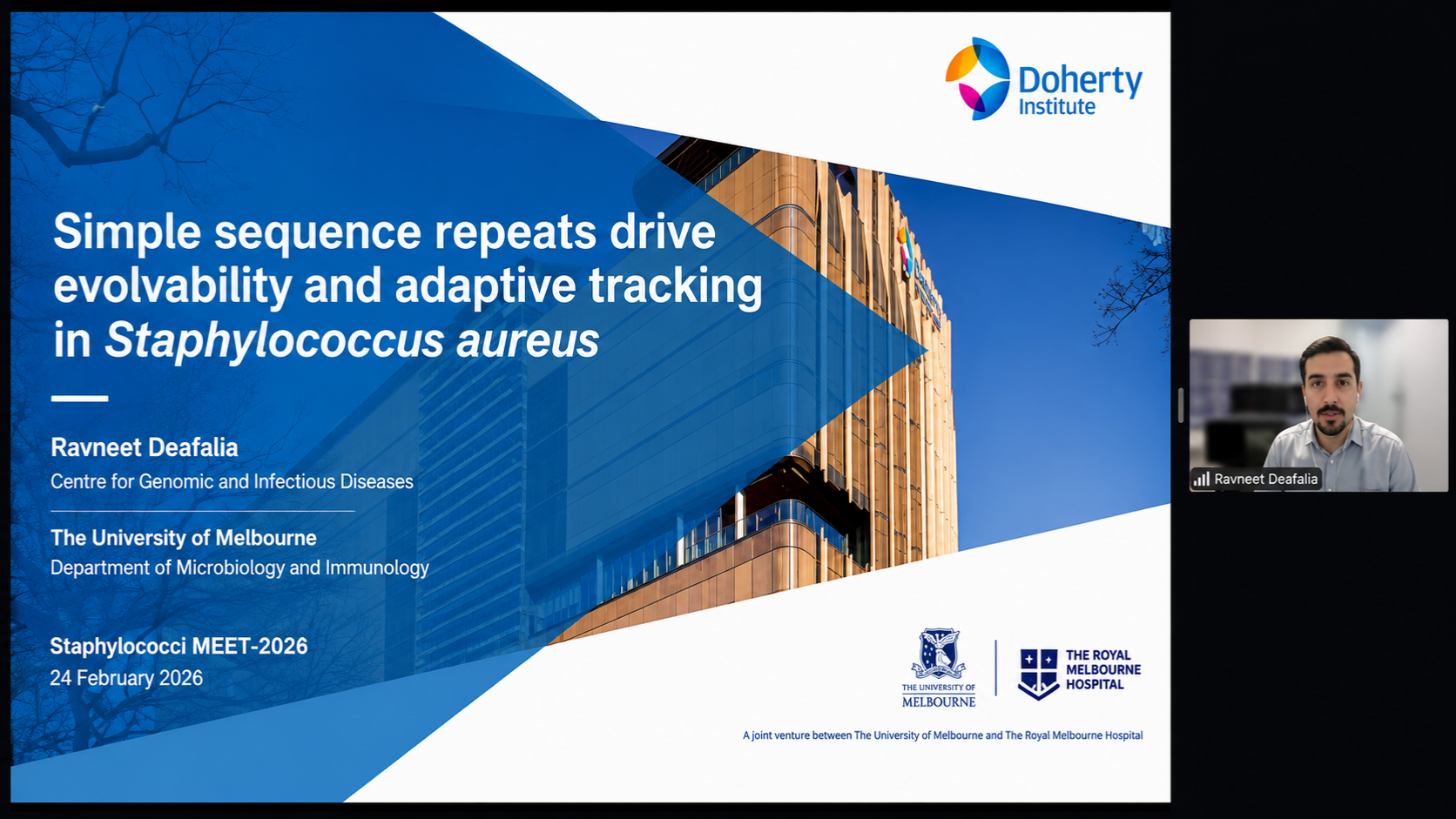
🔴 One of the featured presentations during Session 3 of the 2nd International Virtual Conference on Staphylococci and Staphylococcal Infections 2026 featured Dr. Romain Guerillot from the Peter Doherty Institute for Infection and Immunity, University of Melbourne (Australia), who delivered an insightful lecture on Simple Sequence Repeats Drive Evolvability and Adaptive Tracking in Staphylococcus aureus.
Staphylococcus aureus is remarkably adaptable, enabling it to survive in diverse host environments while responding rapidly to immune pressure, antimicrobial treatment, and changing ecological conditions. One mechanism that contributes to this adaptability involves simple sequence repeats (SSRs), short repetitive DNA sequences that can undergo changes in length during DNA replication. These variations can alter gene expression or protein function, allowing bacterial populations to generate phenotypic diversity without acquiring large-scale genomic changes. Such genetic flexibility provides an important evolutionary advantage, enabling rapid adaptation during colonization and infection. Recent research has increasingly recognized SSRs as important drivers of bacterial evolution and host adaptation.
During his presentation, Dr. Guerillot discussed how simple sequence repeats contribute to the evolvability and adaptive tracking of S. aureus by promoting rapid genetic and phenotypic variation. The lecture highlighted how these hypervariable genomic regions influence bacterial adaptation to changing host environments and selective pressures, providing new insight into the mechanisms that support persistence, immune evasion, and long-term survival. Understanding these evolutionary processes is essential for explaining how S. aureus continues to emerge as a successful pathogen in both community and healthcare settings.
Dr. Guerillot’s research focuses on bacterial genomics, molecular evolution, and host adaptation, with particular emphasis on Staphylococcus aureus. His work combines comparative genomics, microbial population biology, bioinformatics, and experimental microbiology to investigate how genome plasticity shapes bacterial virulence, persistence, and antimicrobial tolerance. Through these approaches, his research is advancing our understanding of the evolutionary mechanisms that enable bacterial pathogens to rapidly adapt to new environments and clinical challenges.
The presentation generated significant interest among conference participants, emphasizing the growing importance of integrating evolutionary biology with microbiology to better understand bacterial pathogenesis. Continued investigation of genome plasticity and adaptive mechanisms is expected to provide valuable knowledge for improving genomic surveillance, predicting pathogen evolution, and identifying new opportunities for antimicrobial intervention.
Stay connected with StemX Media for more live scientific updates from the conference as leading experts share the latest advances in staphylococcal biology, antimicrobial resistance, host–pathogen interactions, and therapeutic development.
This conference is organized by Impact Research Communications (IRC)
More info: https://staph.ircconferences.net/ | Staphylococcus Science & Therapeutics