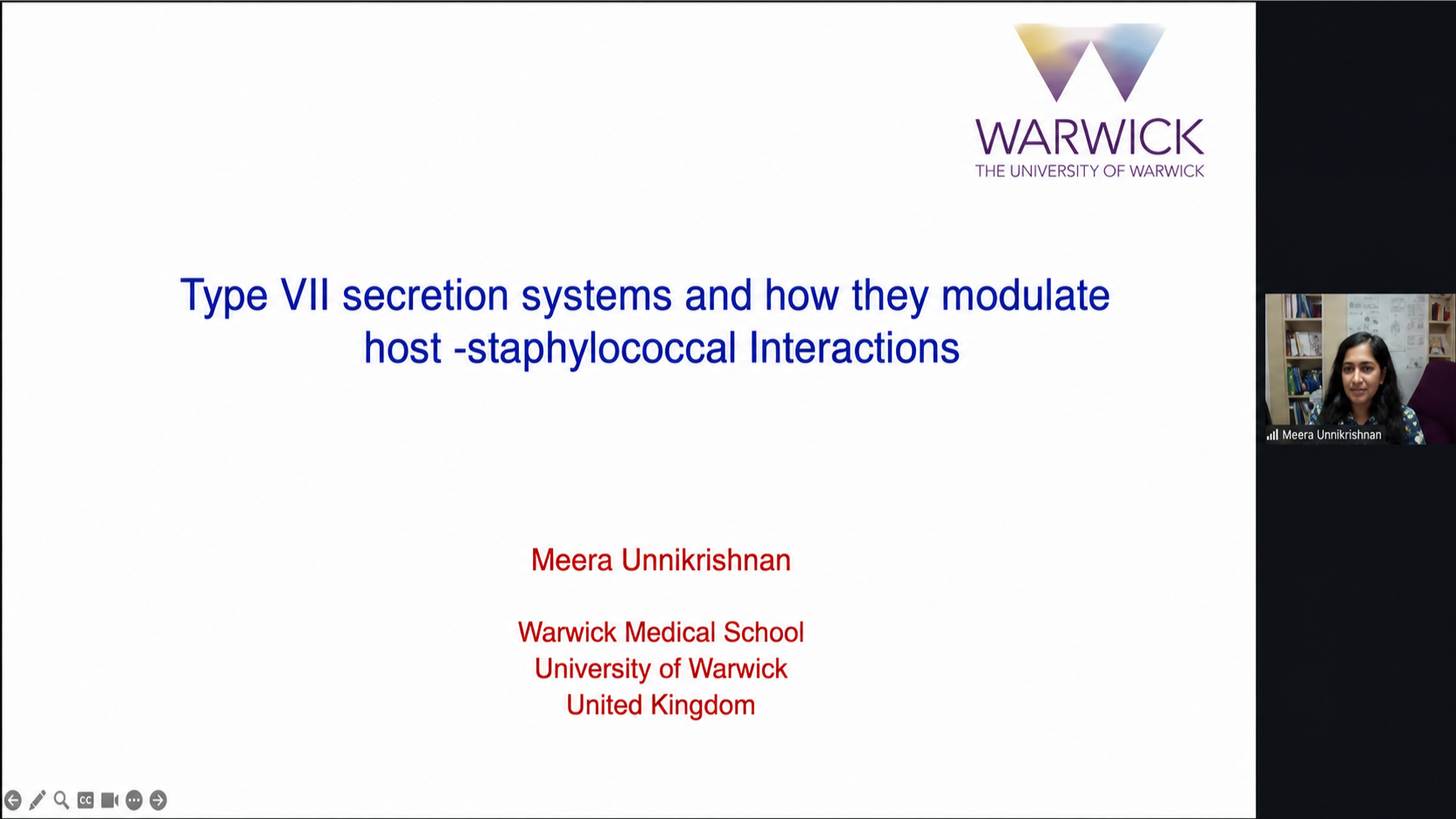
Type VII Secretion Systems and How They Modulate Host–Staphylococcal Interactions
🔴 One of the opening presentations of Session 3 at the 2nd International Virtual Conference on Staphylococci and Staphylococcal Infections 2026 featured Dr. Meera Unnikrishnan from Warwick Medical School, University of Warwick (United Kingdom), who delivered an insightful lecture on Type VII Secretion Systems and How They Modulate Host–Staphylococcal Interactions.
Staphylococcus aureus relies on a diverse arsenal of virulence factors to establish infection, evade host immunity, and compete with other microorganisms. Among these, the Type VII Secretion System (T7SS) has emerged as a specialized protein export machinery that transports effector proteins across the bacterial cell envelope. These secreted proteins contribute to bacterial survival by influencing interactions with host cells, modulating immune responses, maintaining cell envelope integrity, and promoting persistence during infection. As a result, the T7SS has become an important focus of research into the molecular mechanisms that underpin staphylococcal pathogenesis.
During her presentation, Dr. Unnikrishnan discussed how the Type VII Secretion System shapes host–Staphylococcus aureus interactions through the coordinated secretion of virulence-associated proteins. The lecture highlighted the growing body of evidence demonstrating that T7SS contributes to immune modulation, adaptation to host-derived antimicrobial stresses, and bacterial persistence during infection. Understanding the molecular functions of this secretion system provides valuable insight into how S. aureus successfully colonizes diverse host environments while resisting immune-mediated clearance.
Dr. Unnikrishnan’s research has significantly advanced the understanding of the staphylococcal Type VII Secretion System and its role in bacterial physiology and disease. Her laboratory combines microbiology, molecular genetics, biochemistry, and host–pathogen interaction models to investigate how T7SS effectors influence membrane integrity, host immune responses, intracellular survival, and bacterial adaptation. This work has helped establish the secretion system as a promising target for future anti-virulence strategies aimed at disarming S. aureus without relying solely on conventional antibiotics.
The presentation generated considerable interest among conference participants, reflecting the increasing recognition of bacterial secretion systems as central regulators of virulence and host adaptation. Continued investigation into the molecular biology of the Type VII Secretion System is expected to provide new opportunities for the development of innovative therapeutics that interfere with bacterial pathogenesis while reducing selective pressure for antibiotic resistance.
Stay connected with StemX Media for more live scientific updates from the conference as leading experts share the latest advances in staphylococcal biology, antimicrobial resistance, host–pathogen interactions, and therapeutic development.
This conference is organized by Impact Research Communications (IRC)
More info: https://staph.ircconferences.net/ | Staphylococcus Science & Therapeutics