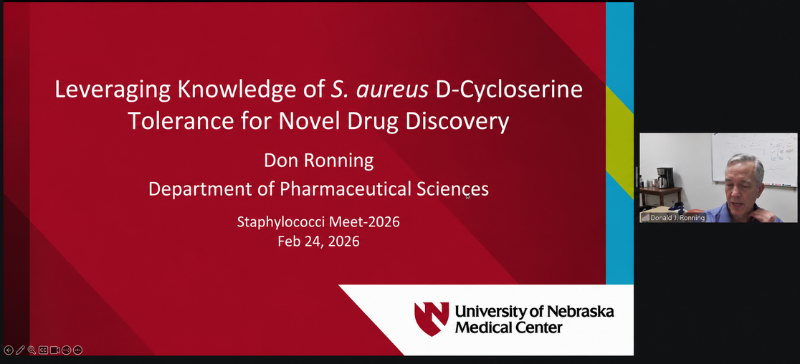
Leveraging Knowledge of Staphylococcus aureus D-Cycloserine Tolerance for Novel Drug Discovery
🔴 One of the featured presentations during Session 6 (Day 2) of the 2nd International Virtual Conference on Staphylococci and Staphyloccal Infections 2026 featured Dr. Don Ronning from the University of Nebraska Medical Center (USA), who delivered an insightful lecture on Leveraging Knowledge of Staphylococcus aureus D-Cycloserine Tolerance for Novel Drug Discovery.
The continued rise of antimicrobial resistance has increased the need to better understand not only bacterial resistance but also antibiotic tolerance, a phenomenon in which bacteria survive antibiotic exposure without acquiring permanent genetic resistance. In Staphylococcus aureus, tolerance to D-cycloserine, an antibiotic that inhibits bacterial cell wall synthesis, provides an important model for investigating how bacteria persist during antimicrobial treatment. Understanding the molecular basis of tolerance may reveal vulnerabilities that can be exploited to improve existing therapies and accelerate the discovery of new antimicrobial compounds.
During his presentation, Dr. Ronning discussed how studying D-cycloserine tolerance can provide valuable insight for the development of next-generation antimicrobial therapies. The lecture highlighted the molecular and biochemical mechanisms that enable Staphylococcus aureus to tolerate antibiotic stress and demonstrated how these pathways can serve as potential targets for drug discovery. By distinguishing tolerance from classical antibiotic resistance, this research provides new opportunities to identify compounds capable of eliminating persistent bacterial populations that often survive conventional treatment.
Dr. Ronning’s research focuses on enzymology, structural biology, bacterial metabolism, and antimicrobial drug discovery. His laboratory combines structural biology, biochemistry, microbiology, and medicinal chemistry to investigate essential bacterial enzymes involved in cell wall biosynthesis and metabolic regulation. Through detailed structural and functional studies, his group aims to identify novel therapeutic targets that support the rational design of innovative antimicrobial agents against Staphylococcus aureus and other clinically important bacterial pathogens.
The presentation generated significant interest among conference participants, emphasizing the growing importance of understanding antibiotic tolerance as a complementary approach to combating antimicrobial resistance. Continued investigation of tolerance mechanisms and bacterial survival pathways is expected to contribute to the discovery of more effective antimicrobial therapies capable of preventing persistent and recurrent Staphylococcus aureus infections.
Stay connected with StemX Media for more live scientific updates from the conference as leading experts share the latest advances in staphylococcal biology, antimicrobial resistance, host-pathogen interactions, and therapeutic development.
This conference is organized by Impact Research Communications (IRC)
More info: https://staph.ircconferences.net/ | Staphylococcus Science & Therapeutics