Spontaneous Preputial Gland Adenitis in Persistently Colonized Male Mice Triggers a Th17-Driven Immune Response
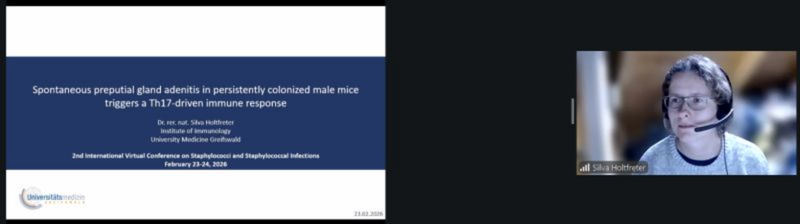
🔴 One of the featured presentations during Session 2 of the 2nd International Virtual Conference on Staphylococci and Staphylococcal Infections 2026 featured Dr. Silva Holtfreter from University Medicine Greifswald (Germany), who presented an insightful lecture on Spontaneous Preputial Gland Adenitis in Persistently Colonized Male Mice Triggers a Th17-Driven Immune Response.
Staphylococcus aureus commonly colonizes the skin and mucosal surfaces of healthy individuals without causing disease. However, under certain conditions, this normally asymptomatic relationship can shift toward invasive infection. Understanding how persistent colonization influences host immunity is therefore essential for explaining why some colonized individuals develop disease while others remain healthy. Experimental animal models that closely mimic natural, long-term colonization provide valuable opportunities to investigate the immune mechanisms that regulate this balance.
During her presentation, Dr. Holtfreter discussed findings from a persistent mouse colonization model demonstrating that spontaneous preputial gland adenitis is associated with a pronounced Th17-driven immune response. The presentation highlighted how long-term S. aureus colonization can trigger localized inflammatory responses and activate adaptive immune pathways involved in host defense. These observations provide important insight into the complex relationship between bacterial persistence, tissue inflammation, and immune regulation, improving our understanding of how colonization may contribute to disease development under specific biological conditions.
Dr. Holtfreter’s research focuses on host–pathogen interactions, adaptive immunity, and the molecular epidemiology of S. aureus. Her laboratory has established mouse-adapted S. aureus colonization models that closely resemble natural host colonization, enabling detailed investigation of antibody responses, T-cell immunity, bacterial adaptation, and mechanisms that influence persistence and infection. This work provides an important experimental foundation for the development of improved vaccines, immunotherapies, and preventive strategies against staphylococcal disease.
The presentation generated considerable interest among conference participants, emphasizing the importance of studying persistent colonization as an active immunological process rather than a passive carrier state. Continued investigation of Th17-mediated immunity and host–pathogen interactions is expected to improve our understanding of staphylococcal colonization biology and support future strategies aimed at preventing infection while preserving protective immune responses.
Stay connected with StemX Media for more live scientific updates from the conference as leading experts share the latest advances in staphylococcal biology, antimicrobial resistance, host–pathogen interactions, and therapeutic development.
This conference is organized by Impact Research Communications (IRC)
More info: https://staph.ircconferences.net/ | Staphylococcus Science & Therapeutics